
Your dog is still vibrating with energy, and your shoulder checked out ten throws ago. That's usually the moment people start searching for the best dog ball launcher.
I get it. Some dogs will chase until your arm is numb, then look at you like the session just started. The wrong launcher makes that worse. It either doesn't throw far enough, dies halfway through play, or turns fetch into a boring machine routine your dog solves in five minutes.
That's why specs alone don't help much. What matters in real life is how the launcher fits your dog's brain, your space, and your tolerance for hassle. The category is growing fast because more owners want tools that handle exercise and enrichment at the same time. The automatic dog ball launcher market is valued at about USD 50 million in 2024 and projected to reach USD 120 million by 2033, according to DataHorizzon Research's automatic dog ball launcher market report.
Here's the short version before we go deep: manual launchers are still the best buy for most owners, and automatic launchers are worth it only if your dog benefits from hands-free, repeatable play and you buy one with the right safety and variability features.
| Launcher type | Best for | What it does well | Where it disappoints | My take |
|---|---|---|---|---|
| Manual launcher | Park trips, active owners, dogs that like handler interaction | Portable, simple, no charging, easy ball pickup | You still do the throwing | Best value for most people |
| Basic automatic launcher | Backyard sessions, owners wanting less physical strain | Hands-free repetition | Can get boring fast, battery claims can be fuzzy | Only worth it if your dog likes repetitive fetch |
| Premium automatic launcher | Smart, high-drive dogs with room to run | Adjustable distance, stronger engagement, better feature set | More expensive, less grab-and-go | Best automatic option if it includes randomization and safety controls |
Table of Contents
- Your Guide to Finding the Perfect Dog Ball Launcher
- Manual vs Automatic Launchers The Core Choice
- Key Features to Compare in Any Dog Ball Launcher
- A Deep Dive into Automatic Dog Ball Launchers
- The Best Manual Launchers for Active Owners
- Matching a Launcher to Your Dog's Size and Play Style
- Essential Safety and Maintenance Tips
- Frequently Asked Questions
Your Guide to Finding the Perfect Dog Ball Launcher
The best dog ball launcher isn't the one with the longest marketing sheet. It's the one that solves your actual problem.
For some people, that problem is physical. Their dog wants endless fetch, and their arm can't keep up. For others, it's time and consistency. They want a tool that can create repeatable play without constant effort. And for owners of sharp, game-driven dogs, the primary issue is boredom. A predictable launcher can become background noise fast.
That's the mistake I see most often. People shop by throw distance first and ignore the session itself. But fetch quality depends on more than how far the ball flies. It depends on whether your dog stays engaged, whether the launcher works reliably, and whether you'll still use it three weeks from now.
Practical rule: Buy for your routine, not your fantasy routine. A big automatic machine sounds great until you realize you mostly play at the park and hate carrying extra gear.
A smart buying process is simple:
- Choose your format first. Manual or automatic changes everything.
- Match the launcher to your play space. Apartment hallway, small yard, or open field all need different throw behavior.
- Think about your dog's mind, not just body. Some dogs want pure repetition. Others need novelty.
- Treat battery claims and “premium” labels with caution. Real-world performance matters more than the box.
If you keep those four filters in mind, the choice gets a lot easier. You stop chasing gimmicks and start looking for a launcher that fits the dog standing in front of you.
Manual vs Automatic Launchers The Core Choice
This is the only fork in the road that really matters at the start. Everything else comes after it.
The broader dog ball launcher market, including manual and automatic systems, was valued at $410 million in 2024 and is forecast to reach $0.7 billion by 2034, growing at a CAGR of 6.8%, according to Market Intelo's dog ball launcher market report. That growth makes sense. Owners want tools that reduce strain and make fetch easier to sustain.
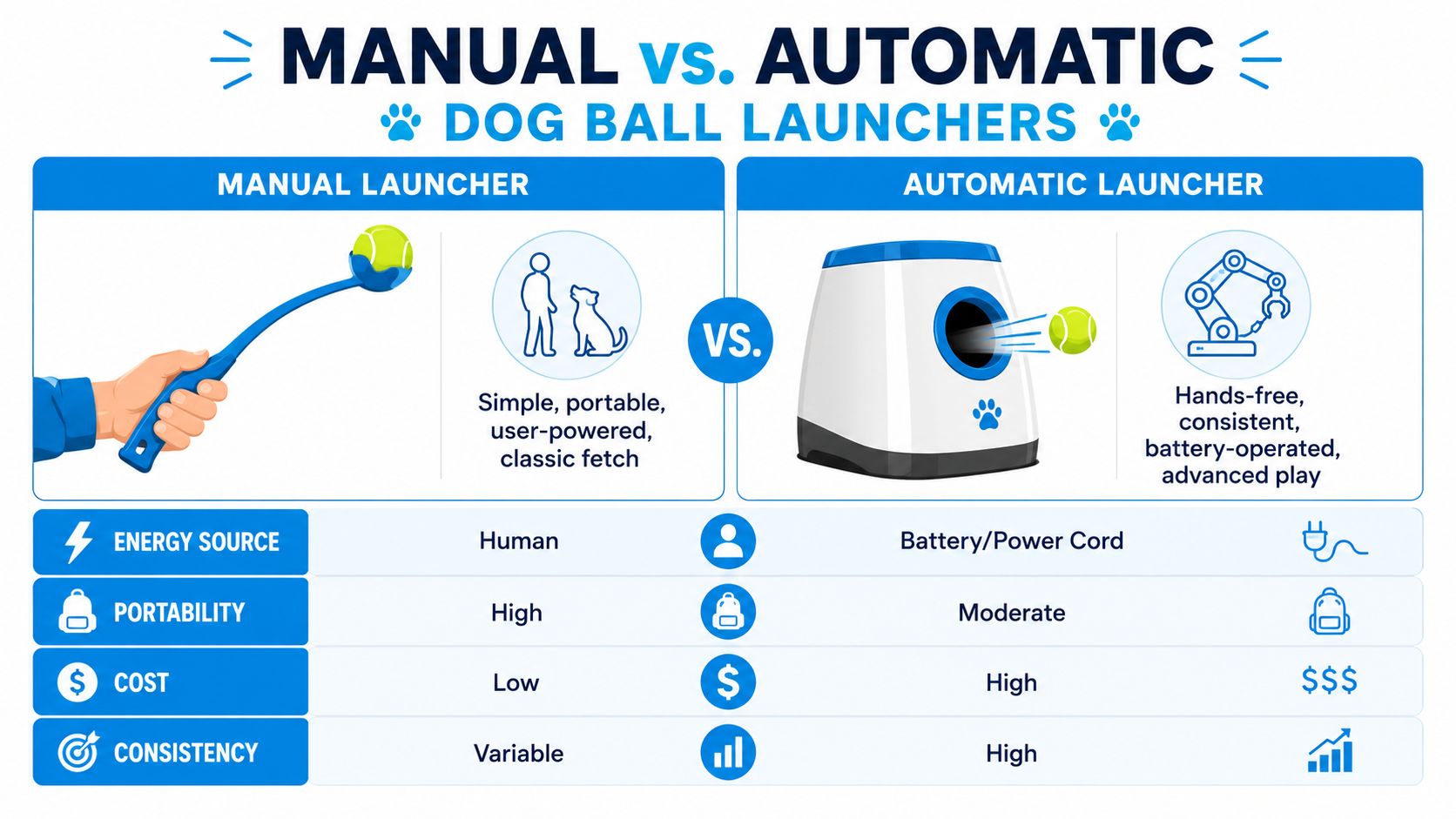
Manual gives you control
A manual launcher is still the cleanest answer for most dog owners. It's lightweight, fast to use, and doesn't ask you to manage charging, setup, or electronics. You grab it, head outside, and start throwing.
That matters more than people think. If a tool adds friction, you'll use it less. Manual launchers also keep you in the game. You control direction, pace, and when to pause. For dogs that need help with impulse control, that owner involvement is a feature, not a drawback.
Automatic gives you endurance
Automatic launchers are better when the owner needs relief or the dog thrives on repeated, structured chasing. If you've got a yard and a dog that can handle station-based fetch, an automatic machine can keep the session going without your shoulder doing all the work.
But convenience comes with trade-offs. Automatic launchers are bulkier, more expensive, and less flexible outside a set play area. They also shift part of the game away from you. Some dogs love that. Some don't.
A launcher that's technically impressive but annoying to haul around usually ends up in a closet.
My direct recommendation
Here's how I'd call it.
- Choose manual if you play at parks, walk to fetch spots, travel often, or want the most reliable low-hassle option.
- Choose automatic if you have a consistent setup space, want hands-free repetitions, or need less physical strain during play.
- Don't buy automatic just because it feels more advanced. Advanced isn't automatically better for your dog.
If you're undecided, start manual. It's the safer bet. Most owners who regret their purchase regret buying too much machine, not too little.
Key Features to Compare in Any Dog Ball Launcher
Specs only matter when they change how play feels. That's the lens I use when comparing any launcher.
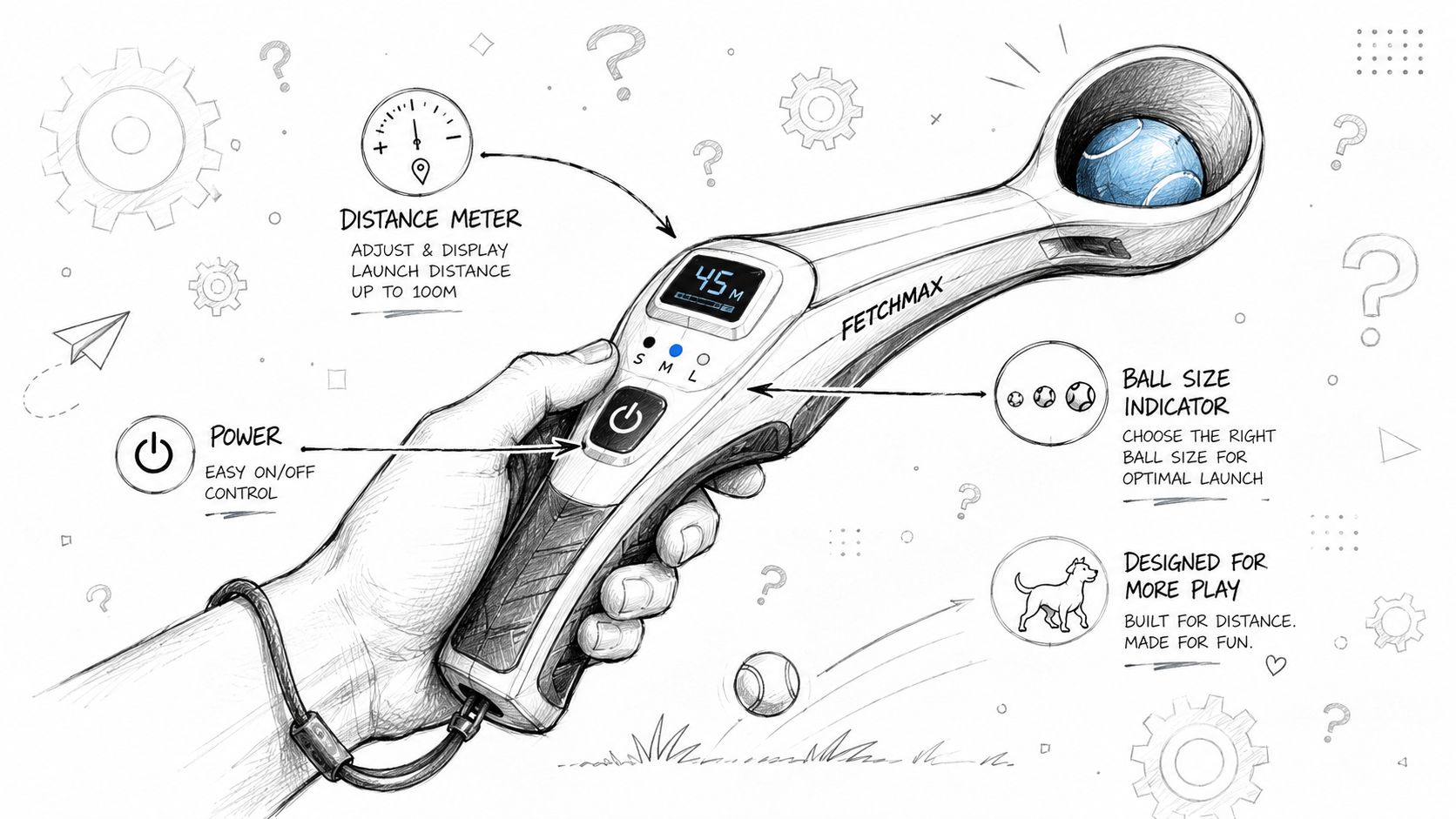
Distance matters less than control
People obsess over maximum throw distance. That's understandable, but it's incomplete. A launcher that can only blast long throws isn't useful in a tighter space or with a smaller dog.
What matters more is adjustability. You want a launcher that lets you shape the session. Shorter indoor tosses, moderate backyard throws, and longer outdoor runs all ask for different settings. Flexibility keeps the launcher relevant instead of limiting it to one environment.
Ball compatibility matters too. If a launcher only works well with one ball size or one exact style, that's a constraint you'll notice quickly. The best dog ball launcher should make your routine easier, not force you into a fussy setup.
Battery claims need skepticism
Many buyers face disappointment regarding battery expectations. Users frequently report inconsistencies between advertised battery specs like “300-800 launches per charge” and actual real-world performance, as discussed in this video review covering reliability concerns with automatic launchers.
That doesn't mean every claim is false. It means battery performance depends on how the launcher is used. Throw distance, session length, ball condition, and stop-start use all affect what you get. Marketing numbers usually describe ideal conditions. Your dog won't play in ideal conditions.
Here's the practical filter I use:
- If you need predictable long sessions, prioritize plug-in use or strong charging convenience.
- If you play in bursts, rechargeable battery models can still make sense.
- If the product leans heavily on launch-count bragging, treat that as a soft promise, not a guarantee.
A short demo helps illustrate the kind of features worth checking in person before you buy:
Safety features aren't optional
A dog that loves fetch will often crowd the machine. That's why safety design matters more than cosmetic extras.
Look for these basics:
- Clear loading area design: Your dog shouldn't need to put their face near the launch point.
- Stable base: A machine that shifts or tips during play creates confusion and risk.
- Easy cleaning access: Slobber, dirt, and worn ball fuzz build up fast.
- Consistent release behavior: Erratic mechanical behavior is not the same as healthy unpredictability.
Buying shortcut: Ignore flashy branding and ask one question. “Will this still be easy and safe to use after muddy fetch sessions and repeated charging?”
If the answer looks shaky, move on.
A Deep Dive into Automatic Dog Ball Launchers
Automatic launchers earn their price only when they do more than throw a ball by themselves. Basic models can feel like novelty gadgets. Better ones change the rhythm of play in a useful way.
What separates premium from mediocre
Premium automatic launchers like iRetriever and UAH Pet offer variable throw ranges from 10 feet to 80 feet, and some add random mode functions plus safety radar features that detect objects within about a 6-foot range to prevent close-range launches, according to Amy Shojai's review of automatic launcher benchmarks.
That combination matters. A machine with short indoor capability and longer outdoor reach is much easier to live with. It can adapt to weather, space, and energy level. Safety sensing matters too, especially for dogs that creep forward and hover near the release point.
Battery design also separates serious machines from frustrating ones. In the same review, the iRetriever is described as taking about 3 hours to charge and running for up to 8 hours nonstop, while the UAH Pet is described at 300-800 launches per charge and the iFetch Too at about 250 launches per full charge. Those numbers don't tell the whole story, but they show how different brands frame performance.
If you're interested in launcher-style play that also crosses into reward-based interaction, a treat-launching dog toy option can appeal to dogs that stay engaged longer when chasing and food motivation work together.
Why randomness beats raw power
This is the feature too many buyers overlook. Randomized distance or angle is more important than another bump in max range for smart dogs.
A dog that knows exactly where the ball will land starts running the route, not playing the game. That's efficient, but it's not always mentally engaging. Random launch patterns force more attention. The dog has to watch, react, and adjust instead of sprinting the same line over and over.
That's why my opinion is simple. If you're paying for an automatic launcher and your dog is bright, athletic, or fetch-obsessed, randomization is the premium feature worth paying for. Not chrome. Not a flashy shape. Not a giant range number.
The Best Manual Launchers for Active Owners
Manual launchers don't get enough respect because they look basic. In practice, basic is often exactly what you want.
Why manual still wins for most people
A good manual launcher solves the biggest fetch annoyances without creating new ones. It throws farther than your bare hand, saves your shoulder, and lets you scoop up a wet ball without grabbing it. That's a strong combination.
It also fits real life better. Manual launchers work at the park, on trails, at the beach, in a field, or during a quick break outside. No battery planning. No setup ritual. No wondering whether the machine will cooperate after sitting in the trunk for a week.
I'm especially high on manual launchers for owners of dogs that stay more connected when the handler controls the pace. You can vary arc, speed, placement, and timing naturally. That variety often keeps the dog more engaged than repetitive machine throws.
Who should skip automatic entirely
Some owners should stop shopping automatic models right now.
- Frequent park-goers: If you don't mostly play at home, portability matters more than automation.
- Owners with muddy, slobbery fetch routines: Simple gear is easier to rinse and keep moving.
- People who hate maintenance: Electronics and outdoor dog play aren't always a happy marriage.
- Dogs that value your participation: Some dogs are chasing the shared game, not just the ball.
Manual launchers aren't the budget compromise. For a lot of people, they're the smarter final choice.
A durable, no-fuss fetch tool is usually the right pick for active owners who want maximum use with minimum hassle. If you want to see the kind of simple grab-and-go product that fits this style, here's a manual ball launcher built for straightforward fetch sessions.
Matching a Launcher to Your Dog's Size and Play Style
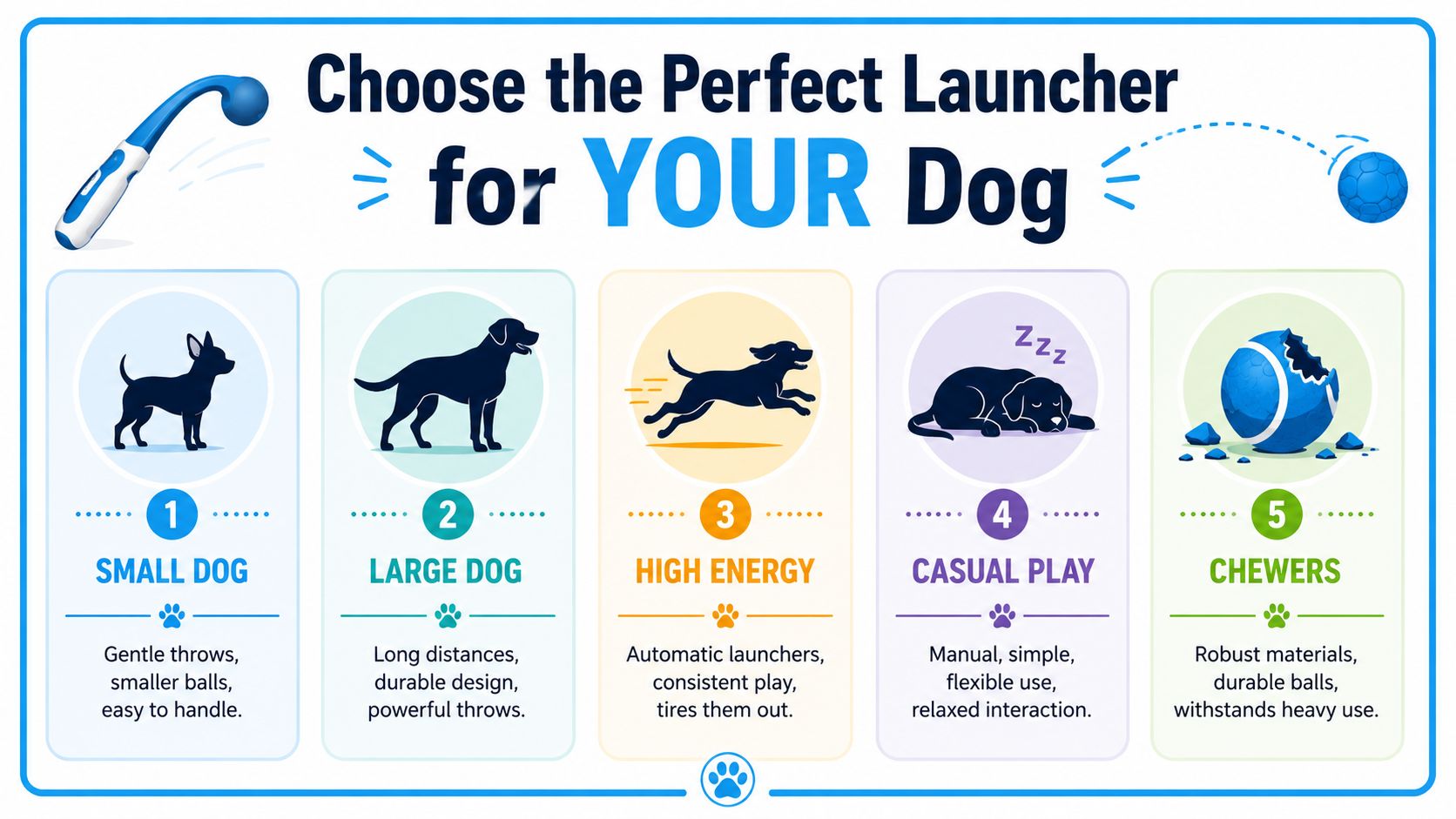
The best dog ball launcher changes depending on the dog. Breed labels help a little, but play style helps more.
The high-energy retriever
This dog wants volume. Labs, working-line mixes, and many herding breeds can do repeated fetch sessions without losing enthusiasm. For them, a launcher should support durable, steady play.
If you've got yard space and your dog already understands the fetch loop, automatic can work well here. If you don't, manual still wins because it gives you range without locking you to one location.
The small-space fetcher
Small dogs and apartment dogs need restraint more than power. A launcher that only shines on long outdoor throws is the wrong fit.
For these dogs, shorter controlled throws are better. Manual launchers are often the safest answer because you can soften the game instantly. If you want to build fetch excitement indoors or in compact spaces, an interactive ball toy designed for dog play can make more sense than a machine built around max distance.
The bored genius
This is the dog most guides miss. The one that learns patterns almost immediately, cuts corners, and starts anticipating instead of engaging. Owners on community forums explicitly ask for launchers that “randomize angle etc”, which highlights a real gap in typical recommendations, as seen in this Reddit discussion about randomized tennis ball launchers.
That detail matters. Dogs with high game-drive often don't need more intensity. They need more uncertainty. When the launcher changes angle or distance, the dog has to stay mentally present.
Here's the fast matching guide I use:
- Choose manual for dogs that thrive on owner-led games, flexible pace, and changing environments.
- Choose automatic with adjustable settings for dogs that need repeated structured exercise in a fixed space.
- Choose automatic with randomization for dogs that get bored fast and start predicting the landing zone.
- Avoid oversized power for smaller dogs or tight spaces, even if the product sounds more impressive.
The right launcher doesn't just tire your dog out. It keeps the game worth playing.
Essential Safety and Maintenance Tips
A launcher is only useful if your dog can use it safely and you can keep it working without drama.
Safe fetch habits
Start with positioning. Your dog shouldn't stand directly in front of an automatic launcher waiting for the ball. Teach them to approach from the side or remain behind the machine until the launch happens.
Also watch the dog, not the clock. Fetch tools make it easy to keep going long past the point where your dog should've taken a break.
- Give water breaks: Excited dogs won't always self-regulate.
- Interrupt the grind: Repetitive sprinting can push some dogs into overarousal.
- End before form falls apart: Sloppy turns, delayed returns, and frantic behavior usually mean it's time to stop.
- Supervise ball condition: Worn, split, or overly dirty balls can affect performance and safety.
Simple upkeep that prevents problems
Manual launchers are easy. Rinse them, dry them, and check for cracks or rough edges.
Automatic launchers need a little more discipline:
- Wipe away dirt and slobber after play.
- Keep the loading and release areas clear.
- Store cords and charging parts carefully.
- Use clean, consistent balls whenever possible.
The fastest way to ruin a launcher is to treat it like it never touches mud, sand, or drool.
That small maintenance habit pays off. Better function, fewer jams, and less frustration during the next session.
Frequently Asked Questions
| Question | Answer |
|---|---|
| Is an automatic launcher better for every high-energy dog? | No. Some high-energy dogs still do better with manual launchers because the owner can vary pace, angle, and timing more naturally. Automatic works best when your dog likes repetitive fetch and you have a consistent space for it. |
| What's the biggest mistake buyers make? | Buying based on max distance alone. Distance matters, but engagement, safety, portability, and reliability matter more in daily use. |
| Can a launcher make fetch less boring for a smart dog? | Yes, but only if the play pattern changes. Dogs that learn the landing zone quickly usually benefit more from variety and unpredictability than from pure power. |
If you want a practical fetch tool without overcomplicating things, browse The Bark Boutique's pet accessory collection. Their lineup focuses on simple, everyday play and care products that are easy to use and easy to live with.
Made with the Outrank app
